
CVD Diamond for High-Performance Heat Dissipation
With a low coefficient of thermal expansion and very high thermal conductivity, CVD diamond can be used for thermal management in high-power semiconductor devices, high-power lasers, microelectronic heat-sink applications, synchrotron and X-ray free-electron-laser beamlines, microwave power components and GaN devices.
Key Properties
- Very high thermal conductivity
- Low coefficient of thermal expansion
- Suitable for high heat-flux and localized heat-dissipation applications
- Single-crystal and polycrystalline material options according to requirements
- Surfaces can be prepared for bonding and metallization
Typical Material / Supply Parameters
| Property | Unit | Typical / Reference |
| Size — single crystal | mm | < Φ30 |
| Size — polycrystalline | mm | < Φ90 |
| Roughness — growth side | nm | <30, polished |
| Thermal conductivity | W/m·K | 1200–2300 |
| Thermal expansion at 293 K | 10⁻⁶/K | 0.8 |
| Thermal expansion, 400–1200 K | 10⁻⁶/K | 1.5–4.8 |
| Isobaric molar heat capacity at 1800 K | J/mol·K | 24.7 |
| Isobaric molar heat capacity at 3000 K | J/mol·K | 26.3 |
Typical Applications
- Heat spreaders
- Thermal-management components
- High-power electronic and optoelectronic systems
- Laser and photonics equipment
- Synchrotron and X-ray free-electron-laser beamlines
What We Can Supply
- CVD diamond plates and customized shapes with application-specific dimensions and thicknesses
- Lapped and polished surfaces according to requirements; Ra <1 nm can be supplied for bonding applications
- Metallization and bonding solutions for arranged small-size diamond components
- CVD diamond microchannel concepts
Metallization
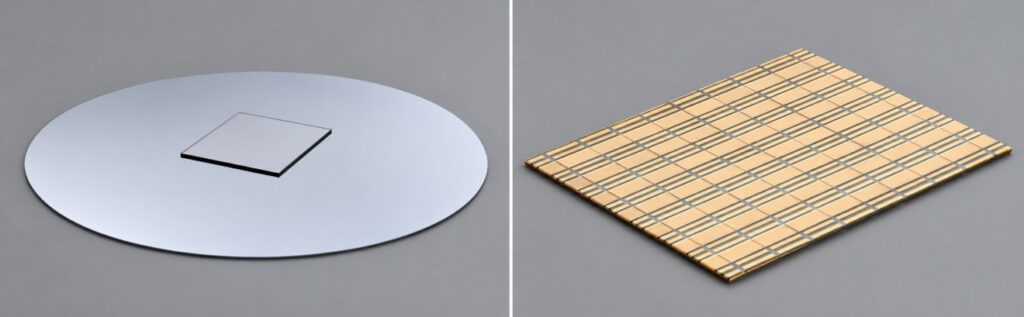
Titanium (Ti) is applied as a carbide-forming layer, followed by Nickel (Ni) to help prevent oxidation and inter-diffusion between solder and the reactive metal layer. A final Gold (Au) or Silver (Ag) layer can provide an oxidation-resistant surface and good wettability for subsequent soldering or wire bonding.
Bonding Technologies for Different Substrate Materials
Depending on the application, including heat spreaders, electronic packages and optical mounts, diamond can be bonded to different engineering materials using application-specific techniques.
- Diamond-to-Silicon (Si) / Silicon Carbide (SiC)
- Diamond-to-Copper (Cu) / Copper-Tungsten (WCu)
CVD Diamond Microchannels
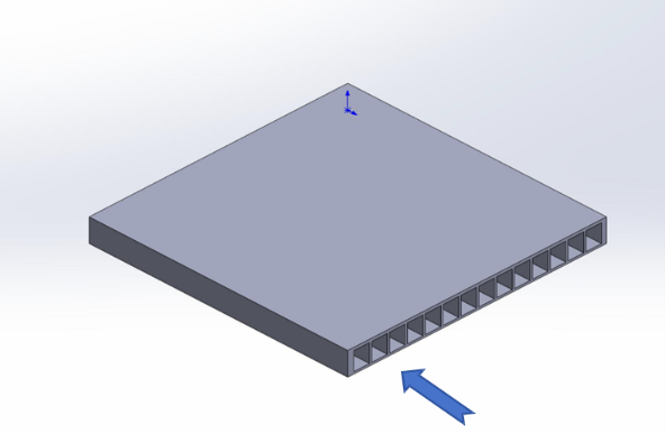
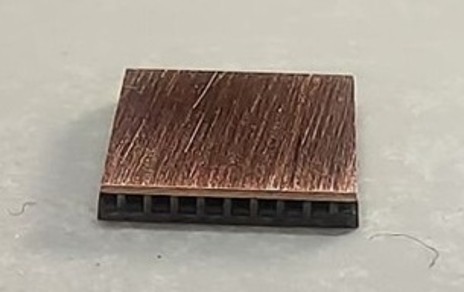
Water flow through a CVD diamond microchannel can be used to remove heat directly from the diamond component. Two source-defined approaches are available:
- Option 1: Direct laser etching of the CVD diamond channel
- Option 2: Laser-etched groove with an adhesively bonded cover
The cover can be CVD diamond, copper or another metal. For adhesively bonded covers, water temperature, flow speed and pressure must be considered to maintain bonding integrity.
Material & Technical Support
Thermal performance depends on material grade, thickness, geometry, interfaces and the complete thermal design. Andrews can discuss material and dimensional requirements with the customer and supply CVD diamond components according to the confirmed specification.
SEND US YOUR THERMAL MANAGEMENT REQUIREMENTS